Thursday, 24 May 2018

2018 is a very busy time for us.

Busy as the bees


Sunday 20 May – Another of our popular one day courses An Introduction to Natural Beekeeping with a chance to “meet the bees” in the afternoon

Saturday 26 May - Launch to the public of the new bee garden at Chester Zoo with a little help from Bee Friendly Collective Todmorden

Saturday 16 June – We’ll be pitching our gazebo as usual at the Todmorden Show at Cliviger.

Saturday 7 July Todmorden Country Fair in Centre Vale Park Todmorden

Sunday 22 July – The second of our An Introduction to Natural Beekeeping courses – spread the word to anyone you think might be interested.


And of course making sure our bees are healthy, catching swarms, mending and cleaning hives and having picnics in the sunshine 

Monday, 11 May 2015

first beefriendly training day of 2015

Blessed with sunshine, after an introduction to bees and natural beekeeping - held inside the OddFellows Hall, Todmorden -  the group went to meet the bees at out allotment apiary.
Kitted out in bee suits, attendees met the bees in one of our warre hives and one of our top bar hives.
An enjoyable day for all, and  and least one new group member.

Our next meet the bees and training day is on Sunday 31st May.


Sunday, 10 August 2014

Rehousing bees

We have recently rehoused two colonies from Warré hives into Top-Bar hives. The first account is by Helmut:

yesterday john, michael n myself moved our bees from warre into the new build top bar. the operation went smooth, only very few cuts had to be made.

the colony was very well equipped with storage (we nicked a bit of honey)
and had good brood. there was some evidence of varoa (deformed bees - but not more than to be expected nowadays).

once again, i found handling / operating in the enclosed space of a warre very difficult, the very small bars offer too little space for the bees to attach comb.
even when you are very cautious cutting the combs loose and lifting with great care the combs like to break when they are full with honey and very heavy.
then bees are trapped in honey.... here were casualties = more than i would have liked.

considering it was quite a big operation the bees were friendly.  although we used the smoker / there was hardly any need for it. 

all in all it took us an hour / from 4 to 5 by 6 all bees were back in the new hive

let's hope they like it!!!!   


The second account is by Michael:

This afternoon at 14-00 hours Alan, John, Philippa and myself met to transfer the bees from the existing hive to the newly built top bar. The existing hive was a top bar with two warrie boxes above each other at one end, the remaining section being completed with top bars.  

The top section of the new hive is the same dimension as a "standard" top bar hive but the sides do not taper they are vertical to accept warrie comb without it having to be cut to fit. The top bars have been designed to screw individually onto the warrie bars enabling easy removal from the warrie to the top bar.

After a discussion to form a method statement and action plan plus the health and safety statement we removed the top warrie box and placed it on a hard surface with a cover on the top to contain the bees. A cover was then placed over the bottom box again to contain the bees. The bottom box was then raised so the comb built below it into the top bar could be inspected, it was found only to be comb so it was removed with a cheese wire.

Both warrie boxes then went through the following procedure

The box was tipped on its side to separate the comb from the side of the box.
The individual rails containing the comb were separated from each other and lifted slightly to free them from the warrie castellations whilst a cloth covered the rest of the rails keeping the bees calm below. Some smoke was used but the bees didn't get to angry with us so we used very little except when we thought a major provocation would cause distress.
The new pre drilled top bars with screws in the two holes were then placed centrally over the warrie top bars and individually screwed into place using an electric screw driver. The completed rail assembly was then lifted and transferred to the new top bar hive, this went well and only one comb broke below the top bar because of the weight of honey in the comb. 
The colony was large possibly 50,000 and although they have built new comb they seem to have been utilising the space vacated by the two earlier swarms. Having said that there were many combs full of brood and stores of honey so the colony is thriving at present. Inevitably there were some bee losses but they were kept to a minimum by the care taken in the method of transfer.
The new top bar hive was closed up after as many bees as possible were "shaken in" and then placed into the existing hive position. The remaining bees then slowly entered the hive after clustering round the access holes. 

The afternoon was concluded with a welcome cup of tea and cake in the shade


Sunday, 22 June 2014

An introduction to natural beekeeping


An opportunity to learn about the philosophy and practice of natural beekeeping – plus a chance to “meet the bees”.    Cost:  £20.00, £10.00 concessions

Places are still available for this one-day course but there's a lot of interest in it so we advise you to contact us (at bee.credible.bees@gmail.com) as soon as you can if you're interested.

Bee Friendly Collective at the Tod Show


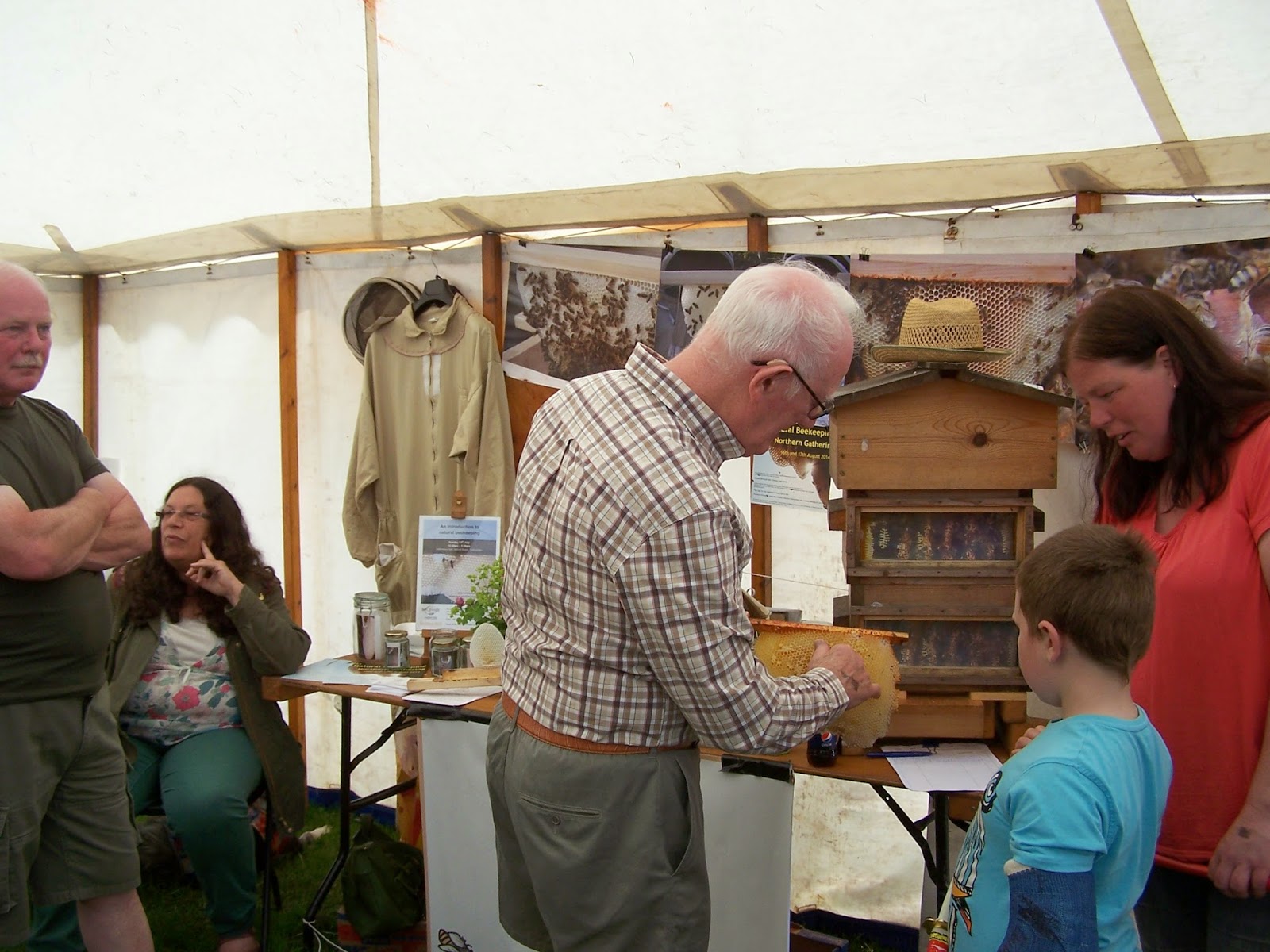
We had a brilliant day at the Todmorden show on Saturday 21st June - very different to our outing two years ago when we the show was under water and we shared a tent with the ferret show.  This year we we in with the Halifax Bee Keepers Association - thanks to Colin Taylor for organising that and his kind words at the end of the day.  There was a steady succession of interested visitors with quite a few of them signing up for our forthcoming training day.  But how we missed those ferrets! 

Sunday, 30 March 2014

spring bees, march on the first day of summertime


it's a while since we last posted. facebook taking over blogging.

but in light of a lovely day out to see the bees and swap the crystallised sugar and fondant for light syrup, thought i'd blog a bit.

spring pollen is coming in - has been for a while. bright yellow reflecting the flora around and about
and the weather is mild. a pleasing 15 degrees today - though hazy


the good news is 3 of our colonies are looking healthy and active. along with the pollen, there's new comb too


an extra box has been added to the garden warre. all boxes full and bees beginning to build in the fondant bag 


sadly, 2 colonies don't look to be doing quite so well. the (once nasty) now placid and all but empty national, and the top warre - but they went into winter a small colony. they both have honey store, and now syrup. doesn't look like there's much we can do other than wait...


Tuesday, 17 September 2013

Natural beekeeper training at Dodnaze Community Centre

Bee Friendly Collective hosted a basic training weekend at Dodnaze Community Centre, Hebden Bridge last weekend 14th and 15th September.

We planned to meet the bees at Redacre Allotments in Mytholmroyd on Sunday afternoon but unfortunately the weather was too stormy to do this so we will re-arrange for a kinder day.

We had a very enjoyable weekend with lovely cake made by Alan and Kerry, and flapjacks and tea made by John. During the weekend a nucleus was formed of people who want to keep bees around the Dodnaze site. We hope soon that this will come to fruition and wish them every success and may their colony grow.

This was a free training, but we asked for donations for the charity Bees Abroad and we will be sending them a cheque for £50. Many thanks to all those who donated. The aim of Bees Abroad is to provide education and technical advice in Beekeeping and suitable business skills.

Thank you to Dodnaze Community Centre Committee who provided the venue free of charge.

Bee Friendly Collective Todmorden offers training to community groups and individuals around Todmorden and further afield if needed. Sometimes we need to pay for a venue and on those occasions we make a small charge to participants with concessions where appropriate.

The training we give is based on low intervention and beekeeping for the bees and not honey production.

Thursday, 20 June 2013

First swarm of the year

On Monday morning bees swarmed from a top-bar kept Marion's garden so John and I went over there to help her collect it.   The swarm was on shrub adjoining the road and so was very accessible.  


After a bit of skilful gardening they easily dropped into the collecting box and after half an hour on an outspread sheet were ready to go - with only a few stragglers left behind. 


 John and I delivered them to the allotment where they were transferred into a Warré hive.

Tuesday, 4 June 2013

Meet the Bees!


We held another training course recently which included a “meet the bees” session in the Allotment apiary. The weather was warm and sunny - and this was reflected in the the mood of the bees. All the hives were opened and inspected including the bees that Phil Chandler had rescued.


The afternoon finished off with the transfer of a colony from a plastic flowerpot into one of our new top-bar hives. Astonishingly they had successfully over-wintered in this unconventional hive and, as you can see from this video, were in great need of more space. Within half an hour all of them had settled into their new accommodation.


Many thanks to Jackie Logue for the videos.

The Barefoot Beekeeper in Todmorden


The much-anticipated visit of Phil Chandler took place last month. Known as "The Barefoot Beekeeper", Phil believes in allowing the bees to follow their natural instincts, with minimal intervention, and is much more concerned about conservation than big honey harvests.  
 
He talked about how he had developed these ideas into practice at a social evening to which local beekeepers had been invited.  All of us found it a truly inspiring occasion.

The following day Phil took a look at some of our hives - starting with the top-bar in the allotment apiary.

Removing unused comb to encourage new comb-building


Phil pointed out how the bees had created a channel to be able to move about the hive whilst conserving heat.


But in another top-bar hives the bees were in a very poor condition and barely alive - only stirring when stimulated by the warmth of our breath.  Phil advised feeding them with sugar.
He then created a hive from a box lined with polystyrene and cut pieces of comb to fit.  We then spent a considerable amount of time putting all the bees that showed any sign of life into iy.
 Lastly he collected the queen in a plastic tube and transferred her to the new "hive". 


You can find out much more about Phil at http://www.biobees.com/


Saturday, 16 March 2013

comic relief


A BIG RED NOSE THANK YOU FROM THE BEE FRIENDLY COLLECTIVE

what easier way to raise some money - that will make a difference - than under the umbrella of comic relief
and
under the shelter of a todmorden outdoor market stall - kindly given
we - buzzing bakers - sold fresh baked fodder


thanks to the generosity of local people who bought our baked goodies and popped donations in the red nose boxes we - collectively - raised £115.70 for comic relief


Sunday, 10 February 2013

burcos and topbars

extracting honey from free formed comb is a challenge... a long process, sticky, waiting game

but, there is another way
recommended to the group
the burco boiler and BBQ trivet


tried and tested by sue
here's sue's account of a job well done


Honey extraction from wild comb
Using the group’s Burco boiler, I have successfully extracted a bit of honey from comb on Warre bars. The comb, very thin and delicate, emerged mostly intact and can be re-used by the bees, so that’s a result.
I put water in the boiler to just above the tap level, set the knob to one and a bit and stood the first bar upside down in a lidded bucket which I put in the water. With the Burco lid kept on, it took about 3 days for the uncapped comb to completely empty of honey and the comb itself softened and bent over and broke in half. The second bar, I enclosed in a hinged BBQ wire griddle inside the bucket to give extra support to the comb – this worked well and at the end the emptied comb quickly cooled and firmed up again. I rinsed the combs to remove the last stickiness and hope to make them available to the bees again this year.
I would think that comb which is not so new, would stand up to the process without extra support. It was quite a painless process and not messy. I would suggest for future extractions standing the upside down bars on something like a wire microwave trivet so the bars don’t end up sitting in the honey.